Duty-of-Care: The legal requirement to prevent exposure to harm and proactively protect employees.
Duty-of-Care Compliance has added organisation & employee benefits:
* Significant employee mental heath protection
* Significant employee & organisational performance elevation and turnover
* & worker compensation claims reduction
Surveys for bullying, job demands, role clarity, incivility, harassment, etc do not meet Duty-of-Care as they wait for employee harm exposure before surveying and acting on them.
EnableOrg® are still the only Psychosocial Risk Compliance platform, with Proactive Harm Prevention. Words can be imitated, but not the delivery. Duty-of-Care Psychosocial Compliance keeps your people safe and your systems risk mitigated to WHS Legal requirements to Prevent Harm.
EnableOrg®’s preventive strategies Protects & Elevates your team with Psychosocial Harm Prevention. Go beyond the staus quo to actual standards for Duty-of-Care for Compliance and sustaining Healthy Culture & Employees.
Psychosocial Harm Prevention, compared to current methods of psychosocial risk surveys, means significantly:
* lower organisational risk and exposure to legal claims,
* lower worker compensation claims,
* less physical and psychosocial incidents and accidents,
* less resources cost and time and personnel as incidents prevented,
* elevated and sustainable mental health and healthy culture and
* meeting actual requirement to Health & Safety Legal Compliance.
.png)
EnableOrg®’s Proactive Risk Management software Protects & Elevates your team with Duty-of-Care Compliance: go beyond bullying, job demand, role clarity, etc surveys and policies, leadership training fixes to future proof with Harm Prevention Compliance.
EnableOrg®’s software risk management system is the only complete Psychosocial Duty-Of-Care solution.
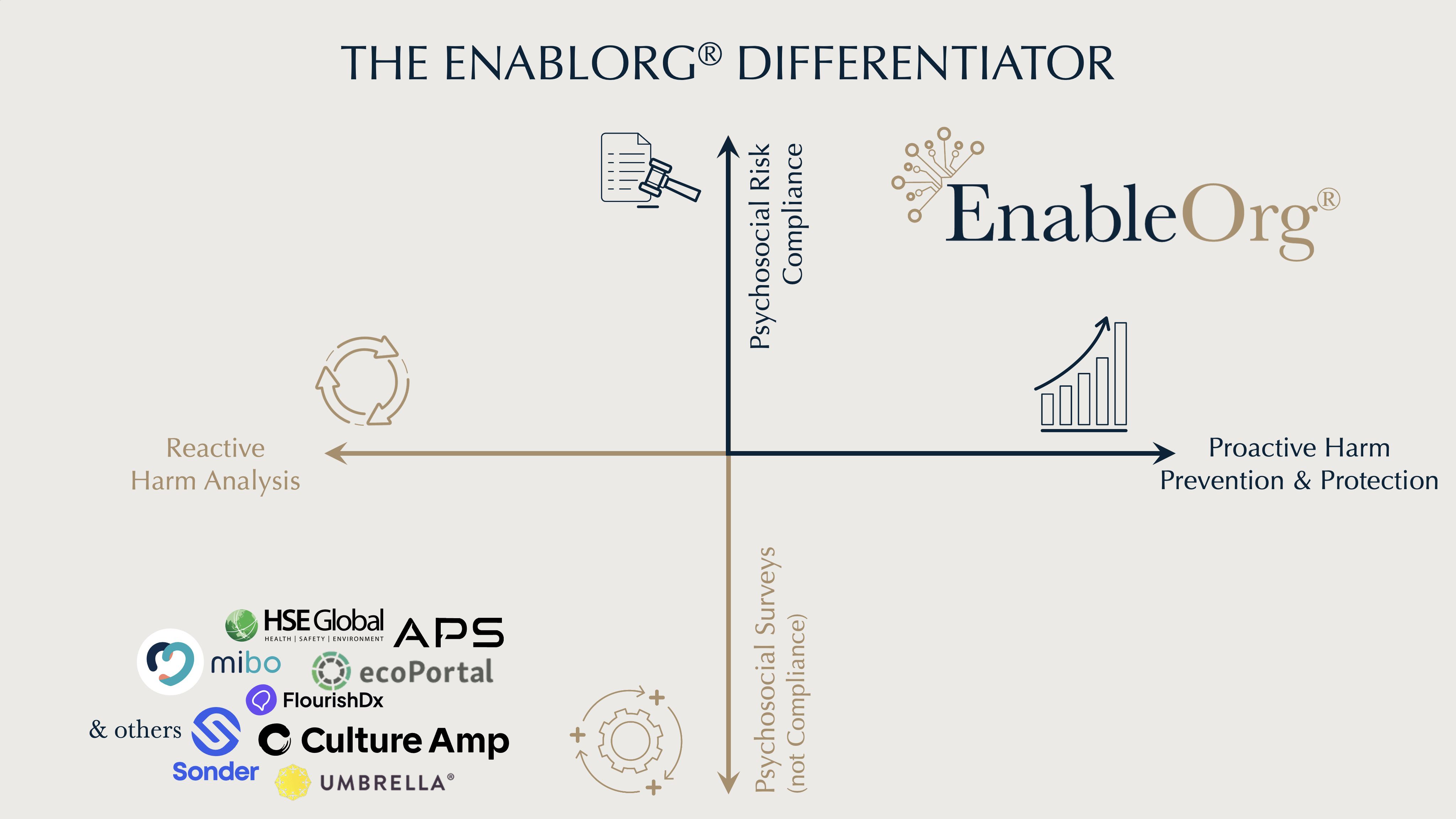
Surveying risks like bullying, job demands, role clarity, recognition, fatigue, workload, injustice etc is useful to get an idea of harm that has already happened, by definition.
A common trap is that systems then get built around these harm analysis strategies long term using this method,
Focus instead on Harm Prevention for Proactive Psychosocial Risk Compliance to treat the causes of risks and see significant benefits beyond harm analysis.
Don’t just log incidents and survey harm. Prevent it in the first place with EnableOrg®’s Elevated Harm Prevention for global psychosocial risk management and compliance. Surveys and incident data are valuable, but they’re retrospective. EnableOrg® allows focusing on prevention, using evidence-based methods to address psychosocial risks before they turn into harm.
For Global Psychosocial Risk Compliance including UK, Australia, NZ, Canada, Europe+. Across any idustry of any size.
.png)
The most common challenge in psychosocial risk management compliance is relying solely on traditional organisational psychology, HR, or wellbeing-led approaches. Strategies such as policies, leadership training, CPD, wellbeing programs, and primary/secondary/tertiary interventions are valuable for culture and support, but do not meet WHS requirements for psychosocial risk management. Recent WHS decisions have increasingly emphasised the need for evidence-based risk controls that directly address identified psychosocial hazards.
EnableOrg® is the industry’s only platform combining deep WHS risk and compliance proficiency with organisational psychology expertise. We understand why these approaches are widely used and how they contribute to a healthy workplace, and we help you align them with what WHS psychosocial risk management actually requires. Bringing you the industry's only Duty-of-Care Psychosocial Risk Management Compliance platform. No HR/Org Psych support system misapplications eg policies, training. No physical risk tools in psychosocial dynamics misapplications eg heat maps, culture as lead indicator.
Our Elevated Proactive Psychosocial Risk Management framework focuses on harm prevention at the source, integrating compliant WHS risk controls with people-focused practices, so you can holistically manage wellbeing and healthy culture and meet psychosocial legal obligations.
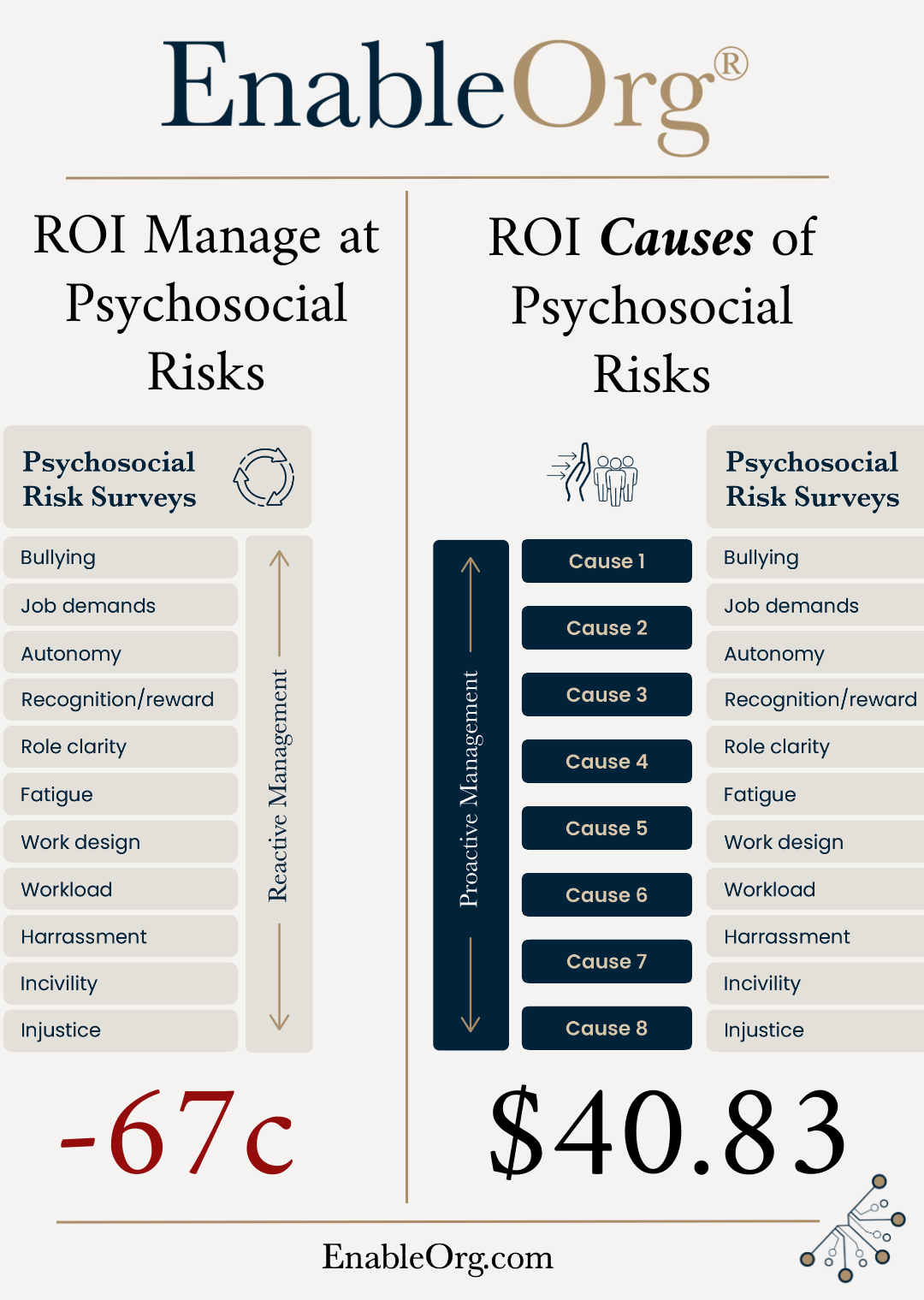
Indicative ROIs of a 500 FTE workplace.
Waiting for people to be harmed as the focus of management. Where copious money is spent on capturing bottom of the cliff incidents and surveys. When you consider this common misapplication it's no wonder that for every $1 the organisation has spent on this strategy, they lose 67c as employees go off sick, suffer presenteeism and absenteeism, fellow employees pick up the workload and are further burdened to stress and burnout, disengagement ensues and even more psychosocial AND physical safety incidents occur. performance goes down, there is an increase in worker compensation claims, and people eventually leave. And the workplace is left open to legal liability as this isn't Compliance, managing via psychosocial risks, only a worksafe guideline to start looking at what they are.
Apply PREVENTIVE measures and manage at the CAUSES of bullying etc, and it's pretty easy to see that people will be more present, like where they work, trust that the organisation is genuinely looking after employees and has their best interests and values them, people will be more engaged and willing to go the extra mile, pay more attention so decrease physical and psychosocial incidents and accidents and want to stay in their jobs. It is easy to see how every $1 spend magnifies to saving $40 through ripple effects of good management to prevent risks, healthy engaged employees and great reputation where top talent actually WANTS to come work. And is actually what Compliance requires.
.png)

Psychosocial factors often play a predominant role in physical safety incidents. We just traditionally have never been looking there.
💢 70-80% of workplace accidents linked to psychological factors:Source: American Psychological Association (APA), "Work and Well-being Survey" (2015)
💢 Employees with high levels of stress are 50% more likely to have workplace accidents or injuries:Source: National Institute for Occupational Safety and Health (NIOSH), "Stress and Health" report (2017)
💢 Depression and anxiety increase workplace accident risk by 30-40%:Source: World Health Organisation (WHO), "Mental Health and Work" report (2019)
💢 Workers with mental health issues are 3x more likely to be involved in workplace accidents:Source: Safe Work Australia, "Work-related Mental Health" report (2020)
💢 Fatigue contributes to up to 20% of workplace accidents:Source: International Labour Organisation (ILO), "Workplace Fatigue" report (2016)
💯 if we really want to manage physical and mental safety for long term reduction, it's establishing a Healthy Culture, where employees feel safe and valued.
.avif)