Proactivly Sustain Healthy Culture Software

FOR Forward thinking Leaders TO BUILD & SUSTAIN HEALTHY CULTURE
PREVENT RISKS. PROTECT EMPLOYEES. ELEVATE ORGANISATIONS. UNLEASH THRIVING.
Don’t just log incidents and survey harm. Prevent it in the first place with EnableOrg®’s Elevated Harm Prevention long term sustainable Healthy Culture. EnableOrg® allows focusing on prevention, using evidence-based methods to address People, Culture, Compliance, Operational issues before they turn into harm.

Healthy Culture.
Protect, Prevent, Elevate.

Why EnableOrg®

Why: Because a genuinely healthy culture is the only sustainable way to protect people, performance, and legal exposure and your reputation at the same time.

How:
EnableOrg® hardwires healthy behaviours into everyday workflows, turning good intentions into consistent, visible leader actions with step-by-step play books.

‍What: A practical operating system for harm prevention that helps every manager build teams where people feel safe, supported, and able to do their best work.

The EnableOrg®Culture Differentiator

EnableOrg®’s preventive strategies Protects & Elevates your whole organisation and employees with Harm Prevention at foundational causes. Go beyond the staus quo to Protect People & Culture with Compliance and Proactive Harm Prevention. Not just react to it after employees have been exposed to stress and psychosocial risks and organisational risks keep recurring.

Protecting your employees, rather than reacting after, first means:
‍
* healthier employees,
* less incidents, accidents, errors,
* reduced overall organisational risks
* more engaged people,
* less turover and absenteeism,
* higher performance and
* better organisational reputation that draws top talent to you, and keeps them. ‍
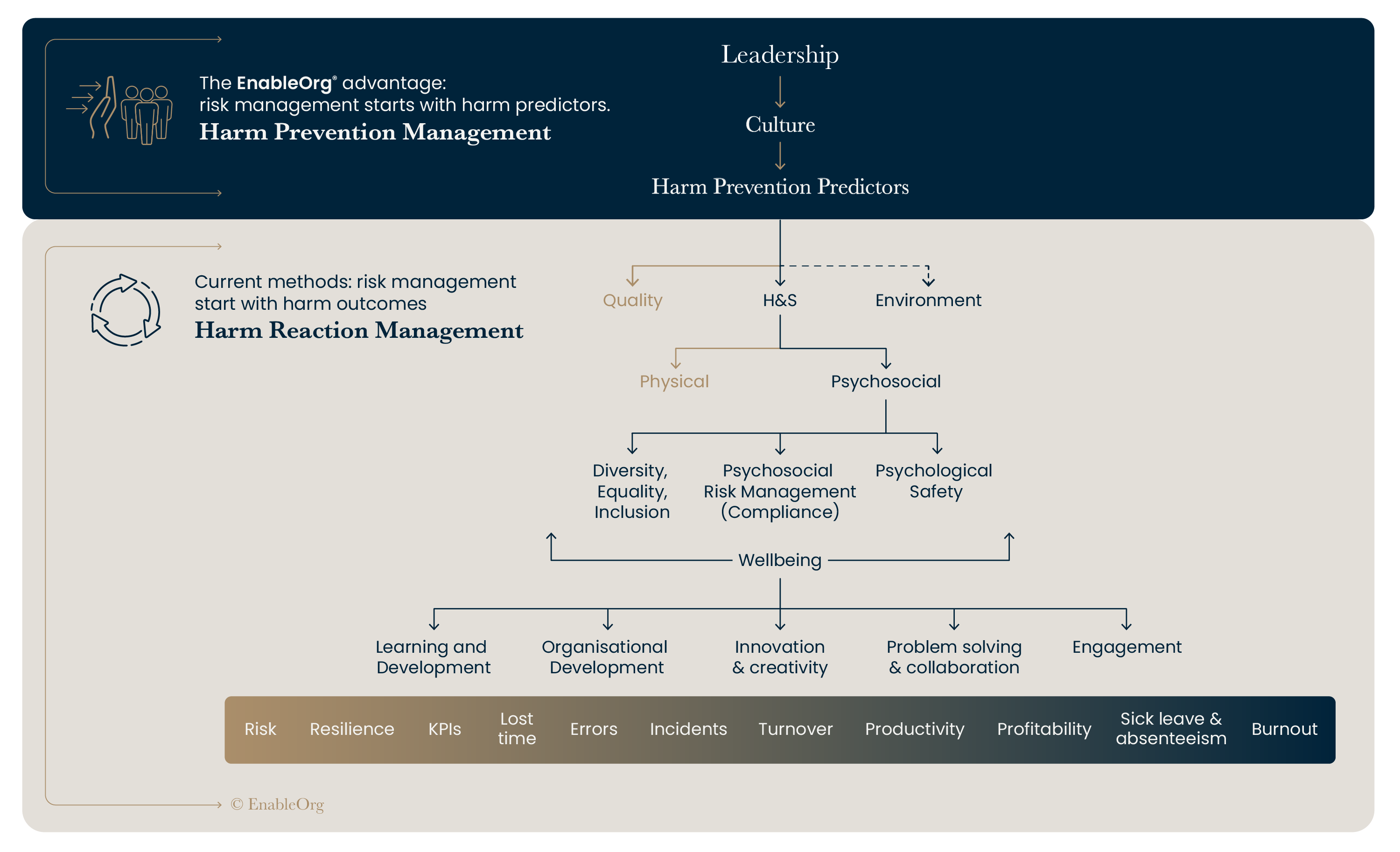
Graph showing Enablorg as proactive with psychosocial risk compliance above others listed as reactive with surveys.

Preventive, not Reactive

Culture & Psychological Safety Harm Prevention

  • Builds trust by addressing issues early, not only after complaints
  • Encourages speaking up, learning and continuous improvement
  • Supports a healthy, high‑performing culture that endures over time
  • Significantly reduces people risks, accidents, incidents as healthier workforce
  • Increases performance and productivity
  • Decreases turnover
  • Reduced workers compensation claims
  • Significantly conserves resources: time, money, personnel, as less incidents to log, investigate, correct, support
  • Lowers legal, financial and reputational risk for the organisation

‍

Abstract 3D cluster of curved shapes in white and blue floating against gradient background.
Cohesive, not Fragmented
  • Builds culture by design, not by accident, using a clear, joined‑up framework instead of reacting to individual incidents or survey scores.
  • Addresses root behaviours and systems  that shape culture every day, rather than chasing surface symptoms.
  • Prevents toxic patterns from taking hold, instead of waiting for complaints, crises or reputational damage before acting.
  • Aligns messages and expectations across the organisation, so people experience consistent culture signals, not mixed messages from different initiatives.
  • Uses one set of measures and actions to shift culture over time, instead of fragmented, short‑lived programs that never stick.
  • Delivers more predictable, sustainable change, because cultural development is continuous and cohesive, not sporadic and reactive.

‍

Abstract metallic layered shapes resembling elongated teardrops overlapping on a light blue background.
Data Simplified, not Data Heavy
  • Reveals the real drivers of culture (leadership behaviour, decision processes, fairness, incentives), not just how people feel about culture today.
  • Enables you to prevent cultural problems (fear, blame, disrespect, silence) before they appear as complaints, scandals or exits.
  • Produces lean, high‑value data that clearly links specific conditions and behaviours to culture outcomes—cutting through noise and vanity metrics.
  • Turns insights into precise cultural levers to pull (what to change in systems and habits), instead of vague themes like “communicate more” or “improve trust.”
  • Reduces survey and report overload by focusing only on cause‑and‑effect data that leaders can act on.
  • Provides stronger evidence for boards and regulators that cultural risks are being identified, treated and reduced over time.
Abstract flowing black lines creating a wave pattern on a white background.