We all want to be 'well', because we feel and function infinitely better when we're physically and mentally healthy. It's intuitive to make the assumption that FOCUSING on wellbeing and 'protecting' mental wellbeing would be the answer to achieving and maintaining this 'feel and function' of wellness. If we want be and feel mentally well than surely 'protecting' and implementing 'wellbeing' will give us lasting and thriving mental health?
Except that isn't how our brains and psychological states are actually built to function. This is a human thing. It is not an industry, country, gender, age, or any other distinguishing thing.
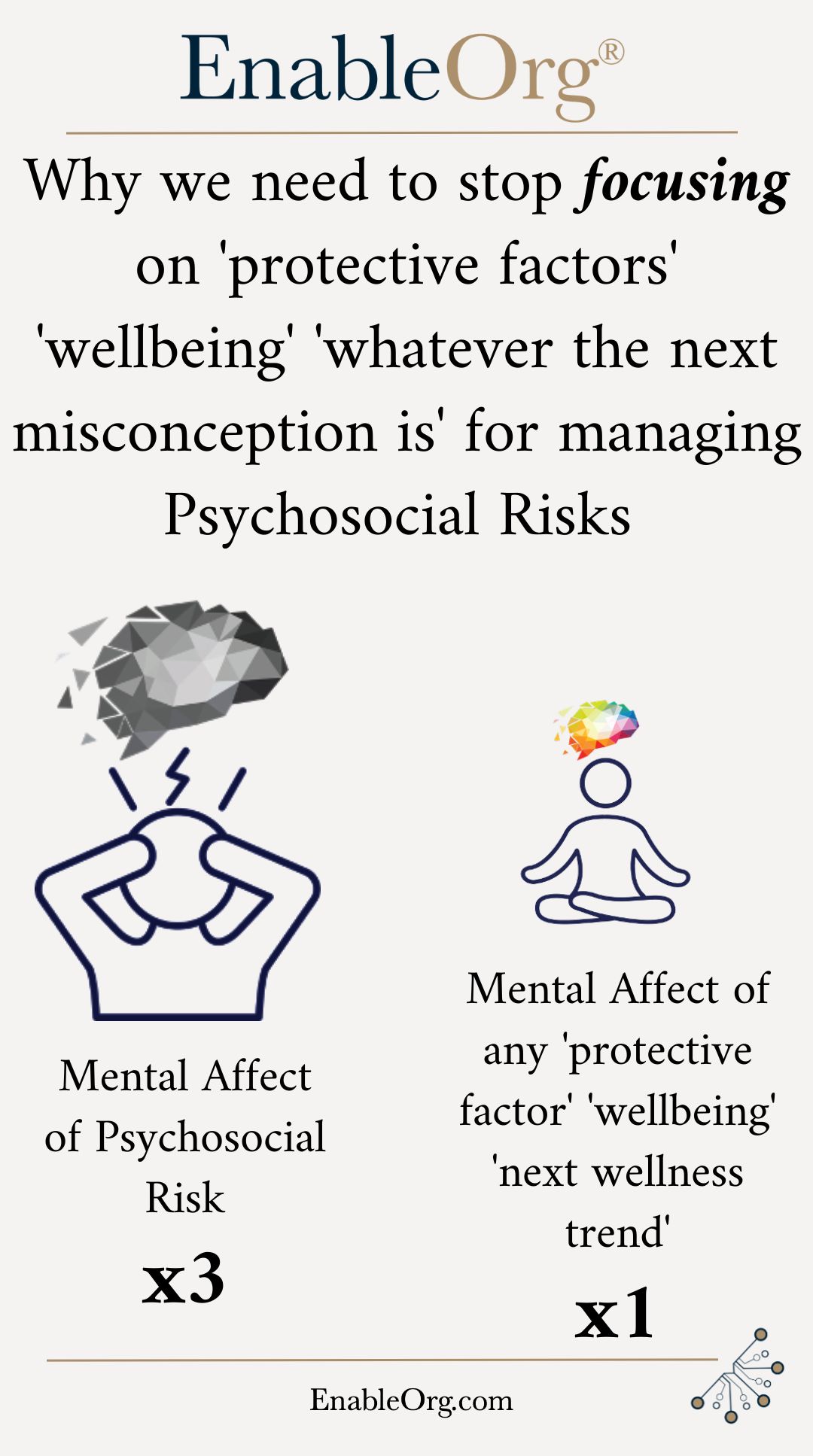
'Wellbeing' Resilience' and the latest trend 'Protective Factors' all perform a similar function psychologically. They are batteries of reserve against mental stress. A limited reserve. They absolutely DO NOT 'protect' from harm regardless of how bad the work environment. Which get depleted when they are drawn on more than they are topped up. And they get drained x3 faster for each encounter with a single x1 psychosocial risk. It isn't a 1:1 balance.
Which means when predominate focus is on what intuitively seems like a good strategy of 'Wellbeing' Resilience' and the latest trend 'Protective Factors', a number of significant risks are added that weren't there before this focus:
****real psychosocial risks go unmitigated, because the attention is place on these feel good 'Wellbeing' Resilience' and the latest trend 'Protective Factors'
****organisational resources like time, money, FTE are being dedicated in places that only have 1/3 of the benefit for each psychosocial risk encounter so never fully provide 'recovery' for the individual from harm
**** it is only a band aid as the real causes of psychological harm continue to be present, so even employees feel better it is for a limited short time anyway as only 1/3 relative benefit AND the cause of the harm is still there so the 'wellness' will wear off quickly and the harm will do x3 the damage in impact
****it actually takes x3 times more money, time, efforts, resources of 'Wellbeing' 'Protective Factors' etc just to bring to neutral the effects of psychosocial risks
And we all feel the reality of this 3:1 psychosocial harm:wellness in our everyday lives. If someone pays us a compliment we feel all warm and happy for a few minutes, maybe half an hour and then forget about it. But when we have our feelings hurt we can easily remember and feel the negative effects of this for years later when when we recount the experience.
That's exactly how and the proportion that psychosocial risk (x3 the harm impact): 'Wellbeing' Resilience' and the latest trend 'Protective Factors' (only x1 transient benefit) works. And that is why it is crucial to eliminate and mitigate risks and keep that the focus, and THEN have 'Wellbeing' Resilience' and the latest trend 'Protective Factors' as an elevating of mental health.