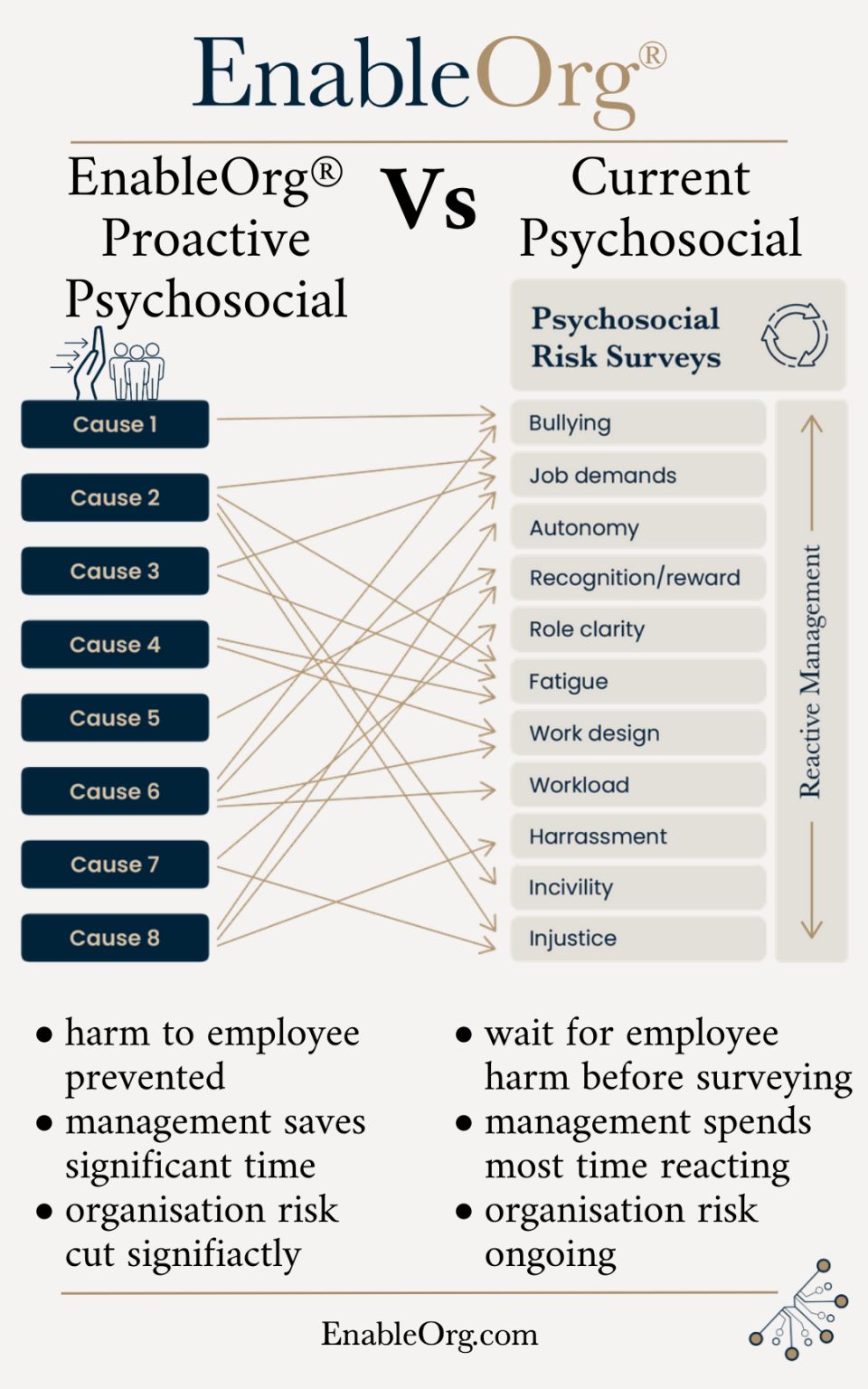
Well intentioned misconceptions are easily the biggest hurdle to sustained employee wellness and Psychosocial Compliance. 'Protective factors' is specifically a set of factors that helps build employee ENGAGEMENT. It is NOT what 'protects' from Psychosocial Risks. Supporting with supervisor support, CPD, autonomy, org culture etc HELPS PEOPLE NOT GET DISENGAGED FROM THEIR JOB TASKS. These factors are NOT proactive risk mitigation which is what Psychosocial risks management is.
Significantly, the reason for this lies in two completely different fields requirements in what intuitively sounds like it would be great for employee support. https://lnkd.in/g8UZMRci (HR, psychologists is not WHS Risk Management (sorry but true). Risks management is a whole field in itself, with specific requirements ie hazards, risks, risk controls. (Parker Vs BHP case law prosecution, eg 'protective factors' are not psychosocial risk management)
This ongoing confusion in terminology is what I see as the top factor in workplaces not meeting Psychosocial Compliance or supporting employees with effective, sustained mental health (which isn't the same as wellbeing) and getting distracted with 'protective factors' (which is for employee engagement, NOT psychosocial risks) and getting caught in this cycle of spending copious efforts in strategies that are well intentioned but perpetuating the very thing they are wanting to mitigate that goes unmitigated because efforts are incorrectly applied.
HR- Employee engagement focuses on enhancing employee motivation, commitment, and job satisfaction to boost productivity, performance, and organisational outcomes.
WHS- Psychosocial Risk Management requires proactively identifying and mitigating hazards that cause psychological chronic stress as a result of the work environment and putting risk controls in place to eliminate or mitigate. In order for something to be a Risk Control they must meet ALL criteria of:
****Be SPECIFIC to the risk/hazard (supervisor support, CPD, autonomy, org culture etc) are not therefore Risk Controls as are general applications that are not specific to anything
****Be able to SHOW DIRECT HARM REDUCTION/elimination with objective data (supervisor support, CPD, autonomy, org culture etc) are not Risk Controls as too large
****Be small tasks ie small enough to manage directly. How will show that supervisor support, CPD, autonomy, org culture etc) have each directly reduced harm? they are large ongoing systems
****OBJECTIVE and measurable DATA to show harm reduction specific to risks (see all points above)
Engagement is a PRODUCT of how well psychological risks are first managed 'Protective factors' are not psychosocial protective factors. and a number of significant risks are added that weren't there before this focus:****real psychosocial risks go unmitigated
****it actually takes x3 times more resources to manage 'Protective Factors' vs psychosocial risks https://lnkd.in/p/g_qqVdRU
EnableOrg.com